Saturday, 8 January 2022

The Power Of The Dog

This is a version of a review heard on ABC Radio Victoria on January 7, 2021.

(M) ★★★★

Director: Jane Campion.

Cast: Benedict Cumberbatch, Kirsten Dunst, Jesse Plemons, Kodi Smit-McPhee, Thomasin McKenzie, Genevieve Lemon, Keith Carradine, Frances Conroy, Peter Carroll.
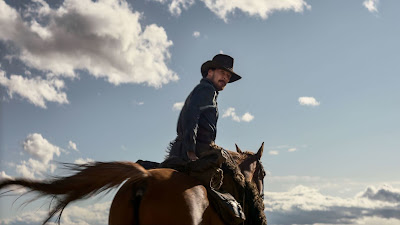
"Sing one more verse of Rawhide, I dare ya!"

There are many mysteries buried within The Power Of The Dog, but perhaps the biggest one is "why has it taken Jane Campion 12 years to make a new feature film?".

Of course the Kiwi director has been busy in that time, but the quiet mysteries and beautiful look of this slow yet intense Western serve as a keen reminder of Campion's skills.

Adapting Thomas Savage's long-forgotten novel, it tells of two wealthy ranchers, Phil and George Burbank. Though brothers, they're like chalk and cheese - Phil (Cumberbatch) is a mean-spirited man living in the shadow of his long-dead idol Bronco Henry, while George (Plemons) is quiet, lonely, and seemingly in search of something more in his life.

When George marries a local widow named Rose (Dunst), it causes friction with Phil, but the arrival of Rose's teenaged son Peter (Smit-McPhee) at the Burbank's Montana ranch sets off a dramatic series of events.


The Power Of The Dog drifts from pretty and plain to unsettling and odd in a matter of moments as it sifts through intriguing ideas about love and loss, masculinity and sexuality, power and pride. Jonny Greenwood's wonderfully evocative score mirrors these subtle tonal shifts, edging into discordance and atonality as the story gets off-kilter. The Radiohead multi-instrumentalist's work is one of many highlights, along with the cast, and the gorgeous cinematography from Ari Wegner.

All of this contributes to the power and beauty of the story, as mysteries slowly unravel in unexpected ways. There's a gothic quality to it all that makes it more of a psychological drama than a western at times, thanks in part to the production design of the Burbank mansion, a strange edifice to civility in the middle of the Montana wilds (for which New Zealand is fine substitute).

Cumberbatch and Smit-McPhee are outstanding in the leads. Cumberbatch plays Phil like a classic bastard but different shades emerge as the film progresses, beautifully realised by the script and the actor. He seemingly softens through his friendship with Smit-McPhee's Peter, a character that also reveals greater complexity as the story progresses. Dunst is also outstanding, though serves as third fiddle to magnetism of Cumberbatch and the creeping strangeness of Smit-McPhee, with the latter threatening to steal the show. Smit-McPhee's is a performance that becomes greater and more impressive the more you think about it after the credits have rolled.

Campion's return to the feature film director's chair is a welcome one, and The Power Of The Dog shows once again her incredible talents as a storyteller. Let's hope we don't have to wait so long again for her next film.

Sunday, 2 January 2022

Don't Look Up

This is a version of a review heard on ABC Radio Victoria on January 7, 2021.

(M) ★★★½

Director: Adam McKay.

Cast: Leonardo DiCaprio, Jennifer Lawrence, Rob Morgan, Cate Blanchett, Meryl Streep, Jonah Hill, Mark Rylance, Tyler Perry, Timothée Chalamet, Melanie Lynskey, Ron Perlman, Ariana Grande, Scott Mescudi, Himesh Patel. 

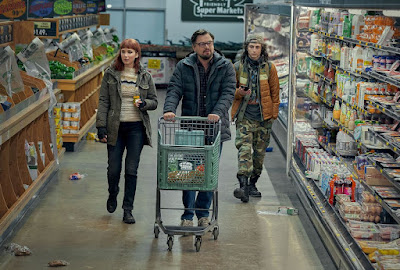
So many specials.

Dear Adam McKay,

If someone doesn't like your movie, it doesn't necessarily mean they didn't get it. They might just think it's a bad movie. This doesn't mean the message is bad, or that they disagree with that message - it probably means they think the film-making techniques employed in communicating that message didn't work for them.

Personally, I liked Don't Look Up, though it's not without its flaws. The fact that I think it's flawed doesn't mean I didn't get it. I understand what the film is about - it's an allegory for climate change, while simultaneously demonstrating the facile nature of the news cycle, the rampant stupidity and inherent danger of social media, the devious economic forces at play within our various world governments, the casual misogyny within our society, and how we're spiralling into an apocalyptic situation of our own making that, ironically, we have the capacity to avert.

I get that. I also laud you for making a film that points out all those things, especially one with such a fine and attention-grabbing cast. Your film, this cast, and the debate generated by Don't Look Up all help draw attention to our plight. Obviously, we are way beyond talking, and the real-life scientists mirrored by the fictional Dr Randall Mindy (DiCaprio) are understandably irate that so little is happening to avoid this climatic disaster. But every little bit helps, and that is what your film is about. And I get that.

But just because you make an important film about an important subject doesn't mean you escape criticism. For example: it's possible to make a shit film about the Holocaust. Just as it's possible to make an imperfect film about climate change.


Mr McKay, usually I don't read other reviews before writing my own, but because you jumped on Twitter to say that people who didn't like the film didn't get it, I did a little bit of pre-reading. I don't agree with some of the overly critical assessments. I fail to see how the film "trivialises" its subject matter, or how it comes off as "cynical" or "insufferably smug" or tackles an "easy target". These reviews miss the point in my view, though that doesn't mean they didn't get the film. While I disagree with their sentiments, it doesn't mean they didn't understand Don't Look Up. And if those reviewers can ably demonstrate how they film demonstrates their failings, then that's fine too.

My own criticisms mirror some of the other criticisms I've seen. The film is longer than it should be (one example: the live-in-concert song that appears with half-an-hour to go wears out its welcome quickly). The tone, which was always going to be difficult to nail due to the subject matter, wanders all over the shop, making the humour fail almost as often as it lands. Your predilection for editing in stock footage works in places, mostly later in the film, and not in others. 

But, Mr McKay, I enjoyed the film. Its satire is so close to the mark that it hurts - the reality is as absurd as the send-up, which makes the film's message all the more pointed. The performances are outstanding. DiCaprio and Lawrence are brilliant, with the latters head-to-heads with Jonah Hill's dim-witted son-of-a-president a particular highlight. Morgan is great, Streep's president is wonderfully diabolical, and Rylance and Blanchett employ their incredible skills to ensure their characters aren't caricatures. And when the laughs land, they're great.

There are some powerful moments too. The ending is gut-wrenching. Seeing DiCaprio and Lawrence's star-gazers screaming their existential dread to an unhearing audience is a big statement. Oh, and the weird sub-plot about a money-grubbing general is hilarious. 

Mr McKay, your film is worthy of a double bill with Idiocracy, and while it falls short of your best film The Big Short, it's an admirable-if-flawed satire that I will heartily recommend despite its flaws. But please remember - someone not liking your film doesn't mean they didn't get it.

Wednesday, 22 December 2021

Dune (2021)

(M) ★★★★

Director: Denis Villeneuve.

Cast: Timothée Chalamet, Rebecca Ferguson, Oscar Isaac, Josh Brolin, Stellan Skarsgård, Dave Bautista, Stephen McKinley Henderson, Zendaya, David Dastmalchian, Sharon Duncan-Brewster, Charlotte Rampling, Jason Momoa, Javier Bardem, 
Chang Chen.

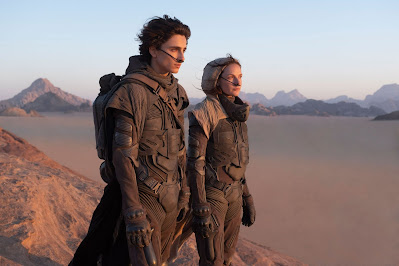
It was true. The sand did look just as sandy from up here.

One of my favourite "sliding doors" moments of cinema is David Lynch passing up the opportunity to direct Return Of The Jedi to instead make Dune. Man, I would've loved to have seen David Lynch's  take on Jedi.

But instead, we got Lynch's version of Frank Herbert's much-loved 1965 sci-fi novel Dune. While it's now something of a cult favourite, it was a critical failure and box office bomb, and Lynch's Dune effectively sank the idea of adapting the book for the big screen for more than 30 years. The fact that it bested Lynch, as well as directors Alejandro Jodorowsky and Ridley Scott (who each tried to make it in the '70s) meant film-makers stayed away, despite the book being the biggest-selling sci-fi novel of all time.

Enter Denis Villeneuve, who's coming off an incredible run of films that includes Sicario, Prisoners, Arrival and Blade Runner 2049. The latter movie is an example of his ability to beautifully realise a pre-existing sci-fi reality; to immediately make it feel real, and to tell a worthy story in that world without getting bogged down. He's done it again with Dune.

Wisely splitting Herbert's hefty tome in half, the film follows Paul Atreides (Chalamet) and his family as they are given control of a valuable planet in the distant future. But there is much to contend with on the planet, including the hostile locals, deadly sandstorms, enormous killer worms, and intergalactic machinations that are guaranteed to leave a trail of blood across the face of the planet Arrakis.


For those who have never read the books, seen the previous film or TV mini-series, played the games or even heard of Dune, the film is immediately accessible. It sets up its worlds, its politics and its players with a deft charm, striking a perfect balance between exposition and immersion.

This helps to make its universe (Dune-iverse?) feel real. A killer cast certainly helps too, as they make sure the characters are fleshed-out people. Chalamet, Ferguson, and Isaac are all fantastic, but no one lets the side down. Every minor character and side player is a cog in the big Dune machine, which is genuinely impressive.

But its the use of effects that really does the job in clinching this reality. Amid every sandblown and windswept scene it's easy to forgot who much CG there is here, but it all feels so wonderfully grounded and immersive. The effects are a great example of how Villeneuve creates worlds, but also the reality he seeks in his storytelling.

This video is awesome at explaining how the Dune team did their effects, and why they work so well:


The upshot of all this is that you are drawn into this world in a way that lets the story be the focus - not the effects and not the fan service. It's a familiar hero's journey, even though it ends on an offbeat due to the book being cut in half (part two is on the way), and Paul Atreides' place in the galaxy is never quite clear. There are notions of honour, duty, destiny and doing the right thing in here, but Dune is somewhat lacking in terms of themes. It's more concerned with plot, which is a weakness but not a damning one.

From its stunning score to its fascinating visuals, Dune tells its story in a powerful and engaging way. If they can maintain this level of quality for the sequel, then there's potentially a new powerhouse sci-fi franchise in town. 

Tuesday, 21 December 2021

Spider-Man: No Way Home (no spoilers review)

(M) ★★★★★

Director: Jon Watts

Cast: Tom Holland, Zendaya, Benedict Cumberbatch, Jacob Batalon, Marisa Tomei, Jon Favreau, Jamie Foxx, Willem Dafoe, Alfred Molina, Benedict Wong, Tony Revolori, JK Simmons.

The extra arms were handy for doing the housework.

Giving the fans what they want is a fraught exercise. Often in films, especially superhero movies, this kind of "fan service" is about stuffing the screen full of Easter eggs at the expense of story and character, and often to the detriment of the casual viewer. It's like the old adage about responsible government - don't give the people what they want, give them what they need.

So if a film can manage to not only meet the wild expectations of fans but exceed those expectations, while also giving them the good story and character arcs a good film needs, then that is truly something special. Marvel has done this before, most notably with Avengers: Infinity War and Endgame. These high watermarks of the franchise stuffed countless beloved characters into a gripping storyline, all the while making sure they got those magical moments of "fan service".

Marvel has done it again with Spider-Man: No Way Home. The film stands on the shoulders of giants, but then somehow pulls the giants up with them. This is a herculean feat of fan service that works because it takes all the "wouldn't it be cool if this happened?" moments and fits them into a story with high stakes, powerful arcs, deep emotions, important lessons and wry humour.

Spider-Man AKA Peter Parker (Holland) finds his life in turmoil, thanks to tabloid media jerk Jonah J. Jameson (Simmons) revealing his secret identity. In desperation he turns to sorcerer Dr Strange (Cumberbatch) to work his magic and make people forget Peter Parker is Spider-Man. But in doing so, they open up doorways into the multiverse, sending Spidey-villains from other universes into Peter's world.


Spider-Man is one of the most beloved Marvel characters for many reasons, and the non-MCU Spidey films that have worked best (Spider-Man, Spider-Man 2, The Amazing Spider-Man and Into The Spider-Verse) have understood those reasons. More so than any other Marvel character, Spider-Man is born out of tragedy, defined by adversity, and constantly has to give up everything to make the world a better place. He's perpetually broke, unlucky in love, and struggles with the imbalances in his life in a way that feels real and relatable. He's always been the most human of the superhumans.

No Way Home gets this, just like Homecoming and Far From Home did. The film puts Spidey through the ringer, all the while cherishing what makes him unique and beloved. The film is full of pathos and heart, and isn't afraid to hit you in the feels hard. A lot of that comes down to Tom Holland's continual brilliance in the role, and a script that understands the legacy of the character and why he works. 

It does all this in the midst of some remarkable fan service. It serves up things you didn't even know you wanted as a Spidey-fan, on top of the stuff you did want. Its villains are enjoyable and the film doesn't suffer from having too many, even if some get little more than the most basic of motivations. The spectacle is on a huge scale, but still manages to keep the characters front and centre.

The Home trilogy is now complete, and leaves Peter Parker in a fascinating and very Peter Parker-esque place. There has been talk of another trilogy, with Holland continuing in the role. Who knows where the character would go next, but as far as Spidey films go, this seems unbeatable. 

Wednesday, 15 December 2021

Venom: Let There Be Carnage

(M) ★★½

Director: Andy Serkis.

Cast: Tom Hardy, Woody Harrelson, Michelle Williams, Naomie Harris, Reid Scott, Stephen Graham, Peggy Lu.

The battle for the chicken had begun.

This is damning it with faint praise, but at least this is better than the first Venom film.

In fact, this sequel to Sony's obvious attempt to milk it's Spider-verse cash cow is reasonably enjoyable in places. It fixes things that were broken in the first film (the tone, the script), and ensures what worked remains (Tom Hardy's Eddie Brock and his relationship with Venom).

But it's by no means a great movie. It feels padded and devoid of heart - it's a big, dumb, silly piece of fun and nothing more.

Brock is still a washed-up reporter, living an Odd Couple-style existence with the symbiote Venom, which continues to share Brock's body. But Brock's career looks to be on the up when Death Row serial killer Cletus Kassidy (Harrelson) picks Brock as the man to share his story with. Unfortunately, that spells bad news for Brock and the city of San Francisco.  


The muddled tone of the original is gone, and new director Serkis leans into the dark comedy that provided the better moments of the first film. While it's still bloodless, there's a darker vibe due to the big bad being a serial killer, as if the movie is slowly edging closer to a time when we can have an R-rated Venom film where heads are actually seen to be eaten. That this is all played for laughs is a relief after last time.

The comedy duo of Brock and Venom is entertaining, and Hardy once again gives his all for the underappreciated role. Harrelson is also wonderfully OTT, and the script attempts to give Kassidy a bit of depth, even if it's all done very simplistically, but at least they made the effort. 

However the film still can't shake the feeling that they don't totally know what to do with these characters. Venom is at his best when he's fighting Spider-Man, and until Sony gets their wish, they're treading water and re-running ideas from the first film - namely that it's symbiote-vs-symbiote, and that Brock and Venom have to get along because they're stronger when they work together.

The script feels padded given the story's simplicity, and could've been done in half the time, but at least the padding is more enjoyable than in the first film. There's some welcome humour that works better this time around, even if the script is still pretty silly (a clue is found carved into a tree for chrissake).

Given the comparative post-COVID success of this, a third film is inevitable. It's hard to see where they'll take the franchise, because it's already starting to feel tired. Sony is absolutely jockeying to get Venom into the MCU, so let's hope it doesn't drag that franchise down to the level of this one.

Sunday, 12 December 2021

The Third Man (1949)

(M) ★★★★★

Director: Carol Reed.

Cast: Joseph Cotten, Alida Valli, Orson Welles, Trevor Howard, Paul Hörbiger, Ernst Deutsch, Erich Ponto, Siegfried Breuer, Hedwig Bleibtreu, Bernard Lee, Wilfrid Hyde-White.

"I knew I should've turned left at Albuquerque."

Here's what I remember from my first viewing of The Third Man 20 years ago - the sewer chase finale, a stray light illuminating Harry Lime's face, the ferris wheel, and the cuckoo clock speech. Each of these moments features that titan of cinema, Orson Welles.

Rewatching Reed's classic noir, it's surprising how little screen time Welles has, but these remembrances illustrate how much he towers over the film. In less than 10 minutes he dominates proceedings enough to earn his sociopathic Lime spot #37 on the American Film Institute's list of cinema's greatest villains of all time

Obviously Welles is a major part of what makes The Third Man such a classic, not only of film noir, but of all film. Lime looms over the narrative just as the shadow of World War II looms over post-war Vienna in the film. If we'd finally met Lime after such a build up and he'd been anything less than Wellesian in his charismatic proportions, it would have undone so much great work. Welles fan and director Peter Bogdanovich also notes Welles' influence on Reed's direction, noting that "the look of The Third Man - and, in fact, the whole film - would be unthinkable without Citizen Kane, The Stranger and The Lady from Shanghai, all of which Orson made in the '40s, and all of which preceded The Third Man". And Welles wrote that pitch perfect cuckoo clock speech.


Of course, there is so much more to The Third Man than Welles - he's the slice of Lime in a gin and tonic, tying it all together, making it all work. To stretch this desperate metaphor to breaking point, the gin is Graham Greene's gripping noir storyline and Reed's use of German expressionism in his direction, while the tonic is the under-rated Cotten in a workmanlike performance, carrying the whole thing along.

Greene hung out in Vienna just three years after WWII ended, picking up stories of the black market and life in the city for his screenplay. Filming there adds so much veracity to Greene's story - the moral decay of Lime and his dubious cohorts is reflected in the destruction of the city. Where once stood beauty and some of humanity's finest achievements now lies rubble and ruin.

Reed, Aussie cinematographer Robert Krasker, and assistant director Guy Hamilton (who did four Bond films) use light and shadow brilliantly to ramp up the noirish tones, throwing in some ambitious-for-the-time Dutch angles to keep the viewer off kilter (The Best Years Of Our Lives director William Wyler famously sent his friend Reed a spirit level in response). These tasty tricks help put you in the shoes of Cotten's equally perplexed Holly Martins, the pulp western writer scrambling to find out what happened to his mate Harry. Cotten did some of his best work alongside his dear pal Welles, and this is among his finest. He makes Martins' an enchanting mix of brash American, clueless everyman, and desperate friend, and by film's end we feel his sense of betrayal and sadness.


Alida Valli and Trevor Howard are also great, as is Bernard Lee and indeed the remainder of the cast, who get to throw some neat gags in to break up the darkness. And when you add Anton Karas' jaunty yet haunting zither score, it rounds off a classic film without a weak spot.

The Third Man has earnt its rightful place as a British classic, though it's almost perceived to done this by accident. As Film Magazine noted while putting the movie at #26 on its 100 Greatest list, Reed "had to settle for Joseph Cotten and Orson Welles" instead of getting James Stewart and Noel Coward. Leslie Halliwell, writing in 1977, called its success "a lucky combination", while Barry Norman, in the process of dubbing it one of the 100 greatest films of all time in 1998, said that "on the face of it The Third Man should simply have come and gone, remembered - if at all - as simply another post-war thriller".

The director was also fighting with Greene over the ending - the writer wanted Holly and Anna to get together, but Reed disagreed. As Greene noted much later, Reed "has been proved triumphantly right", giving us one of the greatest downer finales in cinema, and capping off one of the best films of any generation. As William Bayer put it in his 1973 book The Great Movies, "The Third Man is a flawless film of intrigue and suspense, a summit of perfection within the genre... (it) may be the greatest (British) film since World War II". Bayer was correct nearly 50 years ago, and is still correct today.

Thursday, 9 December 2021

The Beatles: Get Back

(M) ★★★★

Director: Peter Jackson.

Take 413 of Maxwell's Silver Hammer was going surprisingly well.

Believe it or not, some people don't like The Beatles.

I've met some of these strange creatures in the wild and have found them contrary and confusing. Obviously this three-part documentary series is not for them.

But it's also hard to recommend this near-eight-hour-long doco to people with only a passing interest in the Fab Four. There are moments in parts one and two that had me looking at my watch, and I'm obsessed with The Beatles. But they pay off, if you're dedicated.

Obsession and dedication are what is needed to watch all of Get Back. Peter Jackson has made this to be as complete as possible while still making something watchable, fully aware this is could be the last time in a long time someone will get to sift through the 60 hours of film and 150 hours of audio from the Let It Be sessions, as filmed in 1969 by Michael Lindsay-Hogg and his team.


With that once-in-a-lifetime shot in his hands, Jackson has ensured the series paints as complete a picture as possible, piling on the minutiae and fan service. For example, the mentions of manager Allen Klein are ominous, but offer no pay-off within the scope of the doco - it's only the die-hards who know where that goes - while the huge amounts of footage showing the band goofing their way through daft covers and silly jams that aren't album-worthy demonstrate where their heads are at musically, even though it often sounds terrible.

This completeness is both Get Back's biggest strength and weakness. It's fascinating and frustrating because for the first half, The Beatles are shit at rehearsing. The clock is ticking, but they dick around with half-arsed covers from their Hamburg days, or deliberately messing around with their own songs. No wonder George quit and Ringo looks bored out of his brain.  

But as infuriating as it is, it helps contextualise everything. By showing us so much, Jackson helps us understand everything better. George's departure makes more sense than it did in the original Let It Be doco, as does Paul's attitude, which is a mix of fearful indecision and reluctant leader. Yoko's presence is shown to be as benign as most intelligent people always thought it was, John's only as willing as his stonedness allows him to be, and Ringo is just Ringo. 


This excess of material also improves the pay-off of the rooftop concert. There's an incredible exultant joy that comes from watching their final gig after having seen them fumble their way through the previous few weeks. Seeing this historic moment in its entirety, from multiple angles simultaneously - including street level and the cops politely waiting in reception - is another example of Jackson giving us the full context, even though we see repeat performances of the same five songs.

Some favourite moments: the nonchalant way George quits, Paul's reaction to hearing Billy Preston jam with the band for the first time, Preston's incredible talents, seeing Get Back eke its way out of Paul's brain, the remembrances of India, the way they discuss Brian Epstein, Lindsay-Hogg's hilarious concert suggestions, and Paul's cheeky grin when the cops rock up at the rooftop gig.

Get Back is an exhaustive and occasionally exhausting look at The Greatest Band In The World that does something no other Beatles experience has ever done - it makes you feel like you're hanging out with the band. Unfiltered, honest and insightful, it sets the record straight and shows the Fab Four as just four very real humans who happened to make some incredible music together.